- God’s intent is not to make us into better people –at least not as religion and society would define it. Instead He’s developing our ever-increasing trust in Him –transforming us into the perfect bride of the Lamb.
- We can almost measure the changes He’s making by comparing our inner attitudes with Jacob’s sons. (Our outer behaviors take time to catch up with those attitude changes.)
The previous article began with Galatians 4:21-31. That New Testament passage asserts that more can be discerned about our rapport with God by considering the Old Testament stories as allegories (as well as factual history). Within them the women represent relationships to God. In this case Sarah correlates to trusting (faith) –Hagar is subservient obedience (works).
That article went on to identify the next generation’s contentious brothers. Esau represents our human spirit who takes us from one earthly sensual experience to another. He was the first born of the twins. Directly behind him –clinging to his heel– was Jacob. He represents the Holy Spirit who is passionately trying to take over and lead us into eternal life in the kingdom.
Meeting Laban
After selling his inheritance for a bowl of red lentil stew, Esau was bitter and enraged at his brother. So Isaac and Rebekah sent Jacob away –for his safety –and to search for a bride. Rebekah hated the local women with their gods and traditions. She wanted his wife to be someone from Laban’s family –one who shared their heritage. (Laban was Rebekah’s brother –and he was also a distant cousin to Abraham. By the way, that’s what Abraham did too –he sent for a bride from his family for isaac.)
Here’s a short summary of the events that followed. (It begins in Genesis chapter 29.)
- Jacob met and fell in love with beautiful Rachel –his uncle Laban’s younger daughter.
- She came to the well to water her father’s sheep –Jacob rolled the stone away to give access to the water.
- Rachel introduced him to Laban and the two men made an agreement –Jacob would live with her family and work for seven years as payment for marrying her.
- Laban cheated Jacob by replacing Rachel with Leah on the wedding night.
- Jacob married Rachel the week after Leah but it cost him another seven years of labor. (Two servant women were included with the sisters.)
- That second set of seven years is when eleven sons and a daughter were born.
- All of the women gave birth before Rachel –Leah was the first and the most prolific.
- When Rachel finally gave birth it was to Joseph –the favorite.
- He worked six more years during which he bred flocks of sheep and goats –for a total of twenty years.
- Then Jacob took his family and flocks and accumulated wealth away from Laban.
- He met and reconciled with his brother Esau.
- Later Rachel died giving birth to her second son Benjamin –Jacob’s twelfth and last son.
- Jacob adopted Joseph’s first two sons –Manasseh and Ephraim– just before his death.
Here’s a preview of how that fits into the allegory. . .
- The Holy Spirit (Jacob) came to us and foresaw a beautiful relationship was possible (Rachel).
- He rolled away the stone from the tomb (the well) so that we could have living water (making salvation available).
- We invited Him to live within our hearts –and be united with us (promising Him marriage).
- For years (the first seven) He worked to prove His compassion –yet we showed no visible response to His labor.
- We finally accepted Him as Lord (the marriages consummated) but we didn’t merely relate with Him in the way He wanted (beautiful Rachel) –He had to take our worst (Leah) and everything else in between (the servants).
- He labored more (another seven years) and our attitudes began to change (children were born).
- The first change, and most of the others, came through our worst relationship with Him (Leah).
- After making us into the one that we asked for (after most of the children were born) He continued working (six more years building up the flocks) to make us into the beautiful bride that He desired.
- As we mature –after we have left that old heart (Laban) behind and traveled with the Holy Spirit for the best part of our life– He reconciles our spirit (Esau) with Himself (Jacob).
- With sadness we detach from our ties to the people of this world (at Rachel’s death she named him Ben-Oni –”son of my sorrows”) but He gladly welcomes us home (Jacob renamed him Benjamin –”son of my right hand”).
The Women
Now let’s examine the women of Jacob’s story like what was done for those of Abraham’s story in Galatians chapter four. By associating them (representing our relationships to God), their children (as the fruits of those relationships) and their position in the sequence of births, we’ll see His process of drawing us closer to Himself. –Jesus made a similar comparison in His parable of the sower as He described four conditions of the heart in Matthew 13.
Laban
Just what is it within us that the Holy Spirit (Jacob) must deal with? It’s our heart of course –and it’s described in Jeremiah 17:9 and Romans 1:20-23 as being deceitful and dark. We’ll see that Laban portrays the heart perfectly as he cheats Jacob out of his rightful wages.
Laban means “white brick.” Since he’s our heart, being “white” might seem good. But this hard heart is what Jesus was talking about when He said “Woe to you, scribes and Pharisees, hypocrites! For you are like whitewashed tombs which on the outside appear beautiful, but inside they are full of dead men’s bones and all uncleanness” (Matthew 23:27).
Jacob was clear about Laban when he told Rachel “You know that I have served your father with all my strength. Yet your father has cheated me and changed my wages ten times.” And to Laban he said “These twenty years I have been in your house; I served you fourteen years for your two daughters and six years for your flock, and you changed my wages ten times” (from Genesis 31:6-7, 41).
Rachel
Rachel was beautiful. Jacob loved her at first sight. Her name means “to journey as a ewe.” That’s quite a compliment considering that Jesus is the Lamb of God and the Great Shepherd of our souls. He wants us –the love of His life– to follow Him in this life and be His bride throughout eternity. She depicts the secure, perfect, graceful relationship with God that’s developed by continuing to trusting Him more and more.
Bilhah
Laban gave Rachel a servant –Bilhah– as a wedding gift. Her name means “timid, troubled or terrified.” She became Rachel’s substitute for bearing children. Seeing God’s wondrous works in nature –and our meagerness in comparison– makes us timid. It shows in the words we use to describe our relationship with Him –like “awe” and “respect.” And those sermons –about His holiness, our disobedience and the prospect of His wrath– instill just what Bilhah’s name projects, “fear.”
Leah
Laban cheated Jacob by substituting Leah for Rachel on the wedding night. Her name means “to disgust” or “make tired and weary.” Jacob didn’t want her –he was in love with Rachel. Leah describes our maturing (but always lacking) relationship with God. We started out constantly complaining about our circumstances and wanting things to be “better.”
There’s a seemingly unrelated comment about her in Genesis 29:16-18. She had weak (“bad or tender”) eyes. Jesus explained her condition when He said “If your eye is bad, your whole body will be full of darkness. If then the light that is in you is darkness, how great is the darkness!” (Matthew 6:23). That was our condition too. We were in darkness (dead) and needed Him –“life. . .the Light of men” (John 1:4-5).
Zilpah
Laban also gave Leah a servant as a wedding gift. Zilpah means “a trickle of fragrant perfume.” She, like Rachel’s servant, was a substitute child-bearer at times. The meaning of her name alludes to Mary pouring expensive perfume on Jesus’ feet and wiping it with her hair. Zilpah shows our affection and devotion to God.
His Sons
The Holy Spirit’s work within us is a process of growth. This allegory connects our developmental stages to Jacob’s sons and the subsequent tribes of Israel. Each birth describes a deeper, penetrating discovery of who God is –a greater understanding of the grandeur of His love for us –and a new response to His work.
However, just as each previous son continues to live after another is born, our old ways cling with us even while we try to stay focused on the new. They are necessary impediments so that we remember how far we’ve come and don’t become pious. They also help us identify with our brothers and sisters who are going through the same growing pains that we did.
Dinah
Before exploring those steps –the sons– we need to consider his lone daughter. Leah’s last child was Dinah –her name means “to cause” as in to cause a legal decision or judgment. That’s significant because a man from another town raped her. When two of her brothers (Simeon and Levi) found out what happened, essentially they convicted and then carried out the death penalty for him and all of the other men who lived there.
Reuben
Reuben demonstrates how our journey with God began. It was when we realized that nothing in this life worked out the way we hoped –that nothing was truly satisfying –that there must be more than what we found on our own. We cried out to Him and He responded by giving us new life. We were born-again.
(Reuben’s Story)
Reuben’s Story
Leah wasn’t beautiful –she even had an unappealing squint. Her name means “to make disgusted or tired and weary.” She knew that she was unattractive, past her youth, without a husband, and still living in her father’s house. Those were things that no woman wanted. She yearned for a husband who would love her.
When Leah gave birth to Reuben she said “The Lord has seen my affliction now my husband will love me.” (Genesis 29:32) His name comes from two words –meaning “to see” (referring to God seeing her need) and “one born” (His granting her wish for a son). Leah presumed that by having a son she had done her wifely duty and therefore she deserved Jacob’s love.
Reuben was Jacob’s first son –so he would have been the primary heir. But just as we’ve seen with the natural first-born sons before him, something went awry. In his case, he tried to take his father’s place by sleeping with Bilhah, Rachel’s servant (Genesis 35:21-22).
When Jacob was old he made a prediction regarding each of his sons –much like making a last will and testament. Those predictions describe the inheritance that they and their offspring would receive as heirs to God’s promises. Jacob said “Reuben, you are my firstborn; My might and the beginning of my strength, Preeminent in dignity and preeminent in power. Uncontrolled as water, you shall not have preeminence, Because you went up to your father’s bed; Then you defiled it—he went up to my couch” (Genesis 49:3-4).
After bringing that obstinate people out of Egypt and through the desert, it was time for Moses to pass on the task of leadership to another. His last act –before Joshua took them across the River Jordan– was to predict what would become of the tribes. He began by saying “May Reuben live and not die, Nor his men be few” (Deuteronomy 33:6).
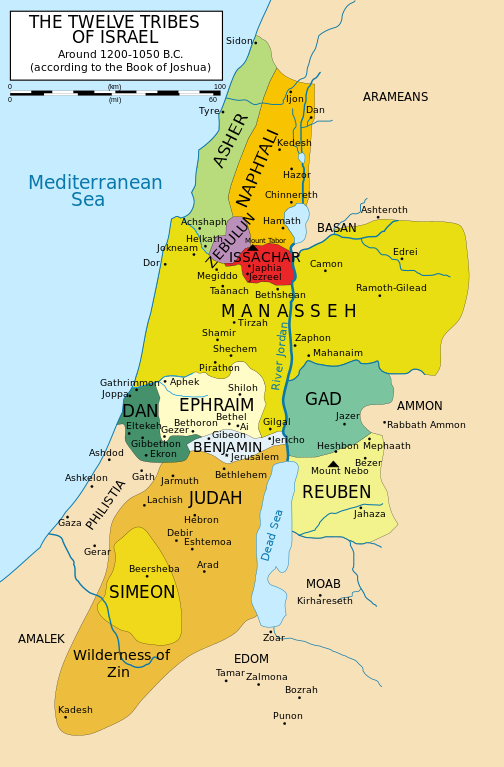
Moses had assigned the general areas of land that the tribes would inherit. Then later, after Canaan was captured, Joshua refined those areas and told them to take possession. Reuben’s land was on the east side of the Jordan River where his forefathers wandered for forty years. It had a narrow border with Canaan on the west. Two other tribes also had lands on that side of the river –Gad and half of Manasseh.
Reuben’s Relevance
The meaning of his name (“to see one born” and “live and not die”) represents being born-again into an eternal life. And it’s not that we deserve it in any way –rather God saved us when we were His enemies (Romans 5:10) –our goodness is like filthy rags (Isaiah 64:6).
What do we new believers do in response to the Holy Spirit (Jacob) working in our hearts (Laban)? We try to be good, spiritual people. But we can only do what we know how –and our ways aren’t good. (Leah’s name describes relating to God with “disgusting, tiring, wearying” ways.) That incident of taking Jacob’s place in bed with Bilhah epitomizes our desperate attempts to produce godly fruits on our own. (Bilhah’s name describes relating to God through fear.)
The relative position of Reuben’s land demonstrates our being in the wilderness when we met God. The narrow border shows that few actually choose to enter His kingdom. And the flowing (living) water of the Jordan River represents our salvation through Jesus which was foreshadowed by Joshua taking his people across. (Jesus’ Hebrew name is Joshua –it means “Jehovah’s Salvation.”)
- Growth-wise: We’ve started –we’re born-again.
Simeon
Simeon depicts our persistent doubts of God’s love and acceptance. We cried out again and He responded by showing us that we can’t experience His compassion through our natural ways –attempting to do good and punish evil. We only prove our own hypocrisy and bring a bad name to the gospel by touting standards that even we can’t maintain. Only God is qualified to judge lives and administer punishment.
(Simeon’s Story)
Simeon’s Story
The ache in Leah’s heart was overwhelming. There was no one who loved her so she cried out to God with expressions of longing. He responded by giving her another son. When Leah gave birth to Simeon she said “Because the Lord has heard that I am unloved, He has therefore given me this son also” (Genesis 29:33). His name means “to hear” (referring to God’s listening) and “consider” (His granting another son).
As Jacob’s second son, Simeon should have been next in line as the primary heir. However, he and his brother Levi (both from Leah) vengefully killed the men of Shechem after one them raped their sister Dinah. That matter brought shame from the neighboring peoples.
Jacob’s words regarding the inheritance were “Simeon and Levi are brothers; Their swords are implements of violence. Let my soul not enter into their council; Let not my glory be united with their assembly; Because in their anger they slew men, And in their self-will they lamed oxen. Cursed be their anger, for it is fierce; And their wrath, for it is cruel. I will disperse them in Jacob, And scatter them in Israel” (Genesis 49:5-7).
More than four hundred years later, when Moses spoke about the futures of the tribes as they were leaving him and entering the Promised Land, Simeon’s tribe is the only one he didn’t mention. Why? It’s because of what Jacob stated. Their significance in the community would be minimal after the attack on Shechem.
Moses and Joshua set Simeon’s land in the southern desert area –surrounded by Judah.
Simeon’s Relevance
The meaning of Simeon’s name (“to hear and consider”) describes what a judge does. As new believers we’re searching for ways to separate ourselves from the rest of the world –and human standards (e.g., morals, ethics, etc.) appear to be a great way since they come from trusted sources (family, friends, teachers, churches, the media. . .).
We don’t realize that it’s the role of judge that we commandeered from God in the garden. Since then, we’re all convinced that we’re experts in defining what’s good and what’s evil. That’s part of our nature –and it seems right, but it’s not. (It comes from our “disgusting, tiring, wearying” ways –Leah.)
Killing off a whole town in response to a rape typifies our ways. But vengeance was only for Jacob (and our heavenly Father) to perform (Deuteronomy 32:35, Romans 12:19).
Simeon’s land was located in the Wilderness of Zin. It shows us that a life of judging (searching for, and finding guilt) feels virtually the same as being lost in the desert.
- Growth-wise: We’re born-again (Reuben) and judging according to human standards.
Levi
Levi conveys the realization that we can’t please God even when we try to live by His commandments. We think that they must be the absolute standard for acceptable behavior and that’s what we preach to the world around us. But it’s just more proof that we’re hypocrites –encroaching on His throne as Judge.
(Levi’s Story)
Levi’s Story
Leah did everything she could to gain Jacob’s affections –and God blessed her with another son. When she gave birth to him Leah said “Now this time my husband will become attached to me, because I have borne him three sons” (Genesis 29:34). Levi’s name means “to unite and abide with” (voicing her desire for Jacob’s undivided love).
Levi was Jacob’s third son. Although the Levites are known for leading Israel with the Law in their priestly duties to the world, Jacob remembered him (and Simeon) for the shame they caused by the brutal attack on the men of Shechem. So he wasn’t the primary heir either.
Jacob’s last words for him (as we saw above) were “Simeon and Levi are brothers; Their swords are implements of violence. Let my soul not enter into their council; Let not my glory be united with their assembly; Because in their anger they slew men, And in their self-will they lamed oxen. Cursed be their anger, for it is fierce; And their wrath, for it is cruel. I will disperse them in Jacob, And scatter them in Israel” (Genesis 49 :5-7).
Moses said about Levi, “Let Your Thummim and Your Urim belong to Your godly man, Whom You proved at Massah, With whom You contended at the waters of Meribah; Who said of his father and his mother, ‘I did not consider them’; And he did not acknowledge his brothers, Nor did he regard his own sons, For they observed Your word, And kept Your covenant. “They shall teach Your ordinances to Jacob, And Your law to Israel. They shall put incense before You, And whole burnt offerings on Your altar. “O Lord, bless his substance, And accept the work of his hands; Shatter the loins of those who rise up against him, And those who hate him, so that they will not rise again” (Deuteronomy 33:8-11).
Levi’s Tribe wasn’t given a plot of the Land. Instead, their inheritance was God Himself (from Deuteronomy 18:1-2). They would live in the cities as ministers to the people there.
Levi’s Relevance
The meaning of Levi’s name describes his tribe’s purpose. It was to “unite” people with God so they would “abide” (be totally comfortable) with Him. They were tasked with officiating over Israel with the Law. It presents the gospel through a set of pictures of the One-and-only Christ and His accomplishments –and conversely it shows that no one else is Him.
The episode at Shechem lets us know that God isn’t pleased with our doing the judging –whether it’s using our standards (Simeon: morals, ethics) or His (Levi: the Law). Not only have we been deciding who’s guilty, we have also been setting the punishment they deserve. It’s quite natural –and it’s displeasing to God (“disgusting, tiring and wearying” –Leah). Vengeance is only for Him to carry out. That’s what Moses was referring to when he said “O Lord. . .Shatter the loins of those who rise up against [Levi], And those who hate him, so that they will not rise again.” He asked the Lord to bring resolution to their conflicts.
Levi’s tribe didn’t receive any property in the Promised Land –which God called “My rest.” It’s to let us know that a person under the Law can be saved but he will be unsuccessful in trying to please Him with endless religious works.
- Growth-wise: We’re born-again (Reuben), judging moral behaviors (Simeon) and trying to live according to the Law.
Dan
Dan drives home the cause and the resolution for being judgmental. We don’t like to submit ourselves to anyone else. It takes away our security –knocking us off the throne that we stole from The Judge– leaving us out of control. But finding out that God is trustworthy allows Him to establish a new, solid security.
(Dan’s Story)
Dan’s Story
Leah was prolific –bearing Jacob’s first three sons– and it immensely frustrated Rachel. Since she hadn’t conceived yet, Rachel told Jacob to produce a son for her through Bilhah (her servant). At his birth Rachel said “God has vindicated me, and has indeed heard my voice and has given me a son” (Genesis 30:6). Referring to that vindication, she named him Dan –meaning “to judge” or “follow a straight course.”
Jacob’s prediction for his fourth* son was “Dan shall judge his people, As one of the tribes of Israel. Dan shall be a serpent in the way, A horned snake in the path, That bites the horse’s heels, So that his rider falls backward. For Your salvation I wait, O Lord” (Genesis 49:16-18). Like those sons before him, he wasn’t the one to receive the main inheritance either.
“Of Dan [Moses] said, ‘Dan is a lion’s whelp, That leaps forth from Bashan’” (Deuteronomy 33:22). Bashan is an area east of the Jordan.
His tribe was large and powerful yet Dan’s land was quite small. And that tribe isn’t listed as one of twelve that comprise the 144,000 witnesses in Revelation.
Dan’s Relevance
Early on we trusted God to provide for our basic needs –that’s what good fathers do. But until we trust Him more, we don’t think of Him as being warm, friendly and compassionate. (Rachel represents relating to God through perfect love.) So we substitute “respect and awe” for love. (Bilhah represents relating to Him through fear –her name means “timid, troubled or terrified.”)
Proverbs 1:7 says “The fear of the Lord is the beginning of knowledge.” Fear is fine a starting point for getting to know Him –but it’s just “the beginning of knowledge.” And it’s not where He wants us to end up. Rather, it’s understanding that “There is no fear in love; but perfect love casts out fear, because fear involves punishment, and the one who fears is not perfected in love” (from 1 John 4:16-18).
Jacob’s prediction describes Dan much like the snakes in Numbers chapter 21. The people had been grumbling since leaving Egypt so God sent serpents to frighten and show them where their faith needed to be. They had to look up at the bronze serpent high on a pole –a picture of Jesus on the cross (John 3:13-15).
Snakes are depictions of judgment –ever since Satan was cursed and called the Great Serpent. They, and the judgment they represent, arouse our natural fears. Here, the horse rared as though looking up and its rider fell on his back –also looking upward to God. Fittingly, the passage ends with “For Your salvation I wait, O Lord.” That’s where our judgmental ways are supposed to take us.
Dan’s small allotment in the Promised Land conveys that fear has very little value in the kingdom and his lack of participation as an end-time witness shows that fearing God is not something to perpetuate. Moses adds more with his comment about him being like a lion’s whelp from Bashan (which was outside the Promise). It shows that our fearful behaviors aren’t from God.
- Growth-wise: We’re born-again (Reuben), trying to be moral (Simeon), trying to keep the Law (Levi) and finding that judging is the result of being fearful.
Judah
Judah shows what happens when we trust Jesus for our eternity. We learn that He’s the Righteous Judge, the Final Avenger, the Mighty Ruler, the Humble Servant, the Living Savior, the Sovereign King –the One who loves us more than life itself. Knowing Him gives us reason to celebrate –praise and thank God for all He has done.
(Judah’s Story)
Judah’s Story
Leah had another son –Judah. He was Jacob’s fifth* son and Leah’s fourth. She named him saying, “This time I will praise the Lord” (Genesis 29:35). His name means, “celebrate” or “praise and thanksgiving.” Then she stopped bearing children for a while.
Jacob said “Judah, your brothers shall praise you; Your hand shall be on the neck of your enemies; Your father’s sons shall bow down to you. Judah is a lion’s whelp; From the prey, my son, you have gone up. He couches, he lies down as a lion, And as a lion, who dares rouse him up? The scepter shall not depart from Judah, Nor the ruler’s staff from between his feet, Until Shiloh comes, And to him shall be the obedience of the peoples. He ties his foal to the vine, And his donkey’s colt to the choice vine; He washes his garments in wine, And his robes in the blood of grapes. His eyes are dull from wine, And his teeth white from milk” (Genesis 49:8-12).
“And this regarding Judah; so [Moses] said, ‘Hear, O Lord, the voice of Judah, And bring him to his people. With his hands he contended for them, And may You be a help against his adversaries’” (Deuteronomy 33:7).
The large size and relative position of Judah’s land shows his importance in the family. Yet, as great as that was, he didn’t receive the primary inheritance either.
Judah’s Relevance
This son of Leah’s marks a grand departure from those before him. At the births of her first three she pleaded and justified her need for love. But at Judah’s birth she turned from doing, to trusting –and from asking, to praising just as his name means –”celebrate” or “praise and thanksgiving.” It’s the start of our knowing the depths of God’s love –and of leaving the whining (“disgusting, tiring and wearying”) behind.
Jacob’s prediction foretells Jesus as the Lion of Judah, associating Himself with Israel, riding on a donkey’s colt, reigning as the eternal King over all people and carrying out justice as the final Avenger. He’s the One we can put our trust in.
Judah’s territory shows that we –even starting out as judgmental zealots (Simeon)– are clothed in Christ’s righteousness (surrounded by Judah).
- Growth-wise: We have eternal life (Reuben), still trying to be moral (Simeon) and trying to keep some of the Law (Levi), judging ourselves and each other (Dan) and discovering God’s amazing love.
Naphtali
Naphtali relates our struggle to understand how God wants us to live. We hear about the need to live moral, righteous lives –to do good and avoid evil– so that we can be Jesus’ faithful representatives. Understanding that He paid the entire price for all sins leaves us with a glorious message to tell everyone.
(Naphtali’s Story)
Naphtali’s Story
Bilhah had one more son for Rachel. Referring to Leah (her archenemy), Rachel said “With mighty wrestlings I have wrestled with my sister, and I have indeed prevailed” (Genesis 30:8). And accordingly, Naphtali’s name means “wrestle” or “morally struggle.” (Incidentally, the word “mighty” in “mighty wrestlings” comes from Elohim –as in “Almighty God.”)
Naphtali was Jacob’s sixth son. Early in the book of Judges he’s noted for failing to drive out the Canaanites when Israel entered the Promised Land. But later he’s portrayed as brave in battles against their enemies. Being a warrior so aptly fits what Rachel named him –after having her own struggles with Leah.
Jacob’s prophetic last words about him were “Naphtali is a doe let loose, He gives beautiful words” (Genesis 49:21). Although this is a wonderful commendation, the primary heir was yet to come.
“Of Naphtali [Moses] said, ‘O Naphtali, satisfied with favor, And full of the blessing of the Lord, Take possession of the sea and the south.’” (Deuteronomy 33:23) Moses was referring to the Sea of Galilee which forms part of the eastern border of Israel. Only Napthali’s land bordered it.
Naphtali’s Relevance
Naphtali reflects the struggle that we all go through while trying to resolve the apparent conflict between God’s perfect love for us (Rachel) and His condemnation for our disgusting ways (Leah). It’s the last fear that we must deal with (Bilhah’s last son). His love (Rachel) prevailed –it’s in the verse “His love endures forever” (from Psalm 136).
The tribe’s effectiveness in battling Israel’s enemies in the Promised Land depicts our growing trust in God. The result is an increasing boldness in expressing God’s reconciliation of the world to Himself and His offer of new life. We want everyone to join us in that victory over death.
Jacob’s prediction is particularly insightful. Naphtali’s land is where Jesus did much of His teaching –where He “gave beautiful words.”
- Growth-wise: We have eternal life (Reuben), still trying to be moral (Simeon), obeying what we can of the Law (Levi), seeing the results of judging good and evil (Dan), loving God (Judah) and becoming outspoken about Jesus.
Gad
Gad reflects our attempts to be Christ-like –trying to tear down the the world’s idols and warning that the end is near. We accept the attacks from traditional religious people and unbelievers –fully convinced that’s our purpose –and we feel assured that we will overcome with Jesus.
(Gad’s Story)
Gad’s Story
Leah continued in her quest for Jacob’s love. But she stopped having children so she gave her servant Zilpah to Jacob to produce another son. When he was born “Leah said, ‘How fortunate!’ She named him Gad” (Genesis 30:11). Gad’s name means “invade or overcome” as in troops winning a battle (referring to her battle with Rachel).
Gad was Jacob’s seventh son. The prediction for him was “As for Gad, raiders shall raid him, But he will raid at their heels” (Genesis 49:19). He wasn’t going to be the main heir either.
“Of Gad [Moses] said, ‘Blessed is the one who enlarges Gad; He lies down as a lion, And tears the arm, also the crown of the head. ‘Then he provided the first part for himself, For there the ruler’s portion was reserved; And he came with the leaders of the people; He executed the justice of the Lord, And His ordinances with Israel’” (Deuteronomy 33:20-21).
After Canaan was sufficiently conquered Joshua gave permission for the two-and-a-half Trans-Jordan tribes (Gad, Reuben and half of Manasseh) to return to the land that Moses gave them on the east side of the river. It was away from their brothers –so before crossing they built a symbolic (non-functioning) copy of the altar of burnt offerings. It was a reminder to those other tribes of their commitment to God and to the community as a whole (from Joshua 22). However, they would be less protected and subject to raiders over there.
Gad’s Relevance
Our perceived warfare is with other religions, corrupt governments and malevolent people. That’s shown by the location of his land. It was on the other side of the Jordan –representing that which hasn’t entered His kingdom. However, God has made it impossible for us to win. He has intentionally corrupted the entire creation so that we must all turn to Him by faith and let Him carry out His justice (Romans 8:20-21).
Gad describes our devotion to God. Zilpah was his mother’s name. It means “a trickle of fragrant perfume” and it’s a preview of Mary pouring expensive perfume on Jesus’ feet (in John 12). We do our very best to win battles in this world for Him (it’s in Gad’s name). Yet the emphasis is subtly on ourselves –it’s we who are fighting the good fight. Even so, God is pleased with what we do (from Moses’ prediction of being blessed). The reason for His pleasure is that we are continuing the task that the Jews were given in their Old Covenant –presenting the gospel through pictures.
- Growth-wise: We’re new creations (Reuben), morals and ethics (Simeon) are less important, we’re still doing our best under the Law (Levi), dealing with self-condemnation (Dan), realizing the magnitude of God’s plan (Judah), telling people about Jesus (Naphtali) and evangelizing the best we know how.
Asher
Asher tells about realizing our continuous state of blessing. We unshakably know that the circumstances surrounding us are a wonderful part of God’s work to bring this body of Christ together as one. And we’re grateful for all things –knowing that they are all precious gifts of His love.
(Asher’s Story)
Asher’s Story
Leah hadn’t given birth since Judah (her fourth). Even Rachel’s servant Bilhad had borne two sons. So Leah had another through her servant. He was Zilpah’s second and last son. At his birth Leah said “Happy am I! For women will call me happy” (Genesis 30:13). She named him Asher –meaning “go forth blessed.”
Jacob’s words were “As for Asher, his food shall be rich, And he will yield royal dainties” (Genesis 49:20). And no, he’s not the primary heir either.
“Of Asher [Moses] said, ‘More blessed than sons is Asher; May he be favored by his brothers, And may he dip his foot in oil. Your locks will be iron and bronze, And according to your days, so will your leisurely walk be’” (Deuteronomy 33:24-25).
Asher’s land was the most northern of Israel’s tribes –and its western side was on the Mediterranean Sea. (Tyre and Sidon are two of its cities.)
Asher’s Relevance
That tribe is significantly mentioned when baby-Jesus was presented at the temple according to the Law (offering a pair of doves to show that their first son was dedicated to God).
And there was a prophetess, Anna the daughter of Phanuel, of the tribe of Asher. She was advanced in years and had lived with her husband seven years after her marriage, and then as a widow to the age of eighty-four. She never left the temple, serving night and day with fastings and prayers. At that very moment she came up and began giving thanks to God, and continued to speak of Him to all those who were looking for the redemption of Jerusalem. (Luke 2:36-38)
Asher –the son of “a trickle of fragrant perfume”– describes believers with a guileless dedication to God. They are like Anna who was wholeheartedly waiting to see the One that she entrusted her life to (the Redeemer). In spirit they have outlived everything else of importance –both people and things.
That land was rich in olive trees and the oil they produce. Throughout the Bible olive oil represents the Holy Spirit. It was used for anointing kings and for illuminating the Holy Place. Our walking in the Spirit is depicted by his foot dipped in oil. And our security in this walk of faith is noted by his locks being made of iron and bronze. Iron conveys emotional peace in this world and bronze is about eternal peace with God.
The message that we tell our brothers and sisters is to wholly rest in the Son –He has done everything to make us pleasing, holy and perfect. That message is welcomed as though it’s directly from above (Moses’ prediction). But those two cities (Tyre and Sidon, which Jesus denounced) allude to resistance that we’ll encounter.
- Growth-wise: We’re new creations (Reuben), treating people with honor (Simeon), pouring out kindness (Levi), minimally judging (Dan), being motivated by God’s love for us (Judah), telling everyone about Jesus (Naphtali), passionately expressing this life as a believer (Gad) and experiencing contentment.
Issachar
Issachar shows that we can be a blessing to other believers by joining them in their rest. He also brings the lost to salvation and exposes our Jewish brothers as having the same purpose in the ministry of the gospel.
(Issachar’s Story)
Issachar’s Story
Leah said “God has given me my wages because I gave my maid to my husband” (Genesis 30:18). She presumed that she had earned Jacob’s affections by providing him with two sons through Zilpah (Gad and Asher). In hopes of gaining even more of his favor, Leah bribed Rachel to exchange their scheduled romantic evenings so that she might have yet another son. The result was Issachar. His name means “brought forth wages.”
(As to the bribe, it consisted of some mandrakes. They were considered an aphrodisiac and fertility enhancer. Reuben had gathered them for his mother while he was at the wheat harvest. Rachel was hopeful that they might put an end to her barrenness.)
Jacob said “Issachar is a strong donkey, Lying down between the sheepfolds. When he saw that a resting place was good And that the land was pleasant, He bowed his shoulder to bear burdens, And became a slave at forced labor” (Genesis 49:14-15). The greater part of the inheritance that Jacob would pass on didn’t go to Issachar either.
Moses spoke of Issachar and Zebulun together. “Of Zebulun he said, ‘Rejoice, Zebulun, in your going forth, And, Issachar, in your tents. They will call peoples to the mountain; There they will offer righteous sacrifices; For they will draw out the abundance of the seas, And the hidden treasures of the sand’” (Deuteronomy 33:18-19).
Issachar’s land is on the west side of the River Jordan –just south of the Sea of Galilee. Parts of it were flat and fertile –good for farming and raising cattle. In other parts, the terrain was treacherous. Life in that land was contentious with recurring attacks from invaders and from nearby Canaanites who maintained strongholds there.
Issachar’s Relevance
Jacob referred to Issachar as a strong donkey –implying that he would have some of the same naturally wild characteristics that his great-uncle Ishmael had. But he would willingly submit himself to hard work when he saw what the task entailed. His description shows maturing believers helping their younger counterparts –Jewish and non-Jewish (between the sheepfolds)– experience a life of faith in the kingdom.
Moses’ reference to the “drawing out an abundance from the sea” tells of fishers-of-men (us in this life –in our tents) bringing people out of death so they can receive eternal life. And “drawing out hidden treasures of the sand” is about exposing the Jews to their glorious heritage that they have been unexpectedly preaching since the time of Abraham. (They are a kingdom of priests to the world who are as numerous as grains of sand.)
Issachar’s land contains the one of the most Biblically notorious places on earth –the city of Megiddo, in the Jezreel Valley, where the great battle of Armageddon will take place. It’s a hint about the difficulties that we will encounter.
- Growth-wise: We’re new creations (Reuben), understanding that morality (Simeon) and keeping the Law (Levi) bring about judging (Dan), however, resting in God’s love (Judah) changes us into promoters of Jesus (Naphtali) and involvement in others’ lives (Gad). We’ve become content sons (Asher) and satisfied, determined, undistracted workers.
Zebulun
Zebulun conveys a sole reliance on God for accomplishing all of the things that He desires –as we work together with other maturing believers.
(Zebulun’s Story)
Zebulun’s Story
When Leah had her last son she said “God has endowed me with a good gift; now my husband will dwell with me, because I have borne him six sons” (Genesis 30:20). Zebulun means “to dwell with.”
-
Jacob’s words about the inheritance were “Zebulun will dwell at the seashore; And he shall be a haven for ships, And his flank shall be toward Sidon” (Genesis 49:13). Yet he’s another who’s not the anticipated heir.
We saw above that Moses spoke about Issachar and Zebulun together. “Of Zebulun he said, ‘Rejoice, Zebulun, in your going forth, And, Issachar, in your tents. They will call peoples to the mountain; There they will offer righteous sacrifices; For they will draw out the abundance of the seas, And the hidden treasures of the sand’” (Deuteronomy 33:18-19).
What’s said about Zebulun’s land implies that it’s next to the sea. There’s mention of the seashore, it being a haven for ships and its side toward Sidon (on the Mediterranean) –but it’s actually landlocked. Understanding these references comes through the meaning of his name. It’s where he “dwelled” –it’s not the location of his allotted land.
Zebulun’s Relevance
Naphtali is on the Sea of Galilee and Zebulun is next to Naphtali. Jesus mentioned them together in Matthew 4:12-17. They are where He did much of His teaching and it’s through that teaching that we have come to know and “dwell with” Him in the kingdom. Like Zebulun, our bodies are still “landlocked” in this world. As such we encourage others’ confidence by letting them know that we are all ships on the sea.
Moses predicted that both Zebulun and Issachar would be “drawing out an abundance from the sea.” It’s a description of fishers-of-men going to meet with people so they can be united with God too. “Drawing out hidden treasures of the sand” makes the task inclusive of the Jews –our forerunners for preaching the gospel.
The port city of Sidon was located to the north and west –in Asher’s land. It was greatly influenced by foreign traders –the very people that Jacob’s mother Rebekah and his grandfather Abraham despised. His reference (“his flank shall be toward Sidon”) lets us know how to consider our enemies to the gospel. It was in the distance –where we might notice their infiltrations. It was not behind –where we might be surprised and overcome by them. Nor was it in front –where we might fixate on troubles they could bring.
- Growth-wise: We’re new creations (Reuben). Morality (Simeon), the Law (Levi) and judging (Dan) have lost their importance. We’re engulfed by God’s love (Judah) and the desire to express it (Naphtali) to friends and even strangers (Gad). Contentment (Asher), joyful endeavor (Issachar) and encouragement describe us.
Joseph
Joseph describes maturity in this life –in the kingdom of God while we’re here on earth. The troubles of this world have finished their intended tasks –making us completely dependent on Him for physical and emotional peace and security. We’re vessels filled with His love who have no other desire than to be available for Him to use as He sees fit for nurturing our brothers and sisters in Christ.
(Joseph’s Story)
Joseph’s Story
Yes, he’s the heir that we’ve been waiting for.
Like Sarah and Rebekah before her, Rachel waited what seemed a very long time to have her first son. At his birth she said “God has taken away my reproach” (Genesis 30:23). Joseph’s name means “abundance.”
Jacob had this to say about his favorite son. “Joseph is a fruitful bough, A fruitful bough by a spring; Its branches run over a wall. The archers bitterly attacked him, And shot at him and harassed him; But his bow remained firm, And his arms were agile, From the hands of the Mighty One of Jacob (From there is the Shepherd, the Stone of Israel), From the God of your father who helps you, And by the Almighty who blesses you With blessings of heaven above, Blessings of the deep that lies beneath, Blessings of the breasts and of the womb. The blessings of your father Have surpassed the blessings of my ancestors Up to the utmost bound of the everlasting hills; May they be on the head of Joseph, And on the crown of the head of the one distinguished among his brothers” (Genesis 49:22-26).
“Of Joseph [Moses] said, ‘Blessed of the Lord be his land, With the choice things of heaven, with the dew, And from the deep lying beneath, And with the choice yield of the sun, And with the choice produce of the months. ‘And with the best things of the ancient mountains, And with the choice things of the everlasting hills, And with the choice things of the earth and its fullness, And the favor of Him who dwelt in the bush. Let it come to the head of Joseph, And to the crown of the head of the one distinguished among his brothers. ‘As the firstborn of his ox, majesty is his, And his horns are the horns of the wild ox; With them he will push the peoples, All at once, to the ends of the earth. And those are the ten thousands of Ephraim, And those are the thousands of Manasseh’” (Deuteronomy 33:13-17).
Joseph didn’t inherit any of the land –but in a way he received twice as much. His sons, Manasseh and Ephraim, were each given a land of their own. Jacob’s inheritance for those two grandsons in found in Genesis chapter 48. It tells that in effect he adopted them as his own sons and then repeated the “skipped inheritance” by giving the greater blessing to the younger –Ephraim.
Manasseh’s land was divided –half was far to the west –on the shore of the Mediterranean. The other half was far to the east –with Reuben and Gad on the other side of the Jordan. Ephraim’s land was high up on a ridge –figuratively making all of the other tribes look up to him (the “crown of the head of the one distinguished among his brothers”).
Joseph’s Relevance
We all know the Sunday school story about him. Joseph ended up sold into slavery in Egypt by his jealous brothers. They took his bloody coat-of-many-colors back to Jacob claiming that he must have been killed by wild animals. Joseph became second in command and was responsible for storing up food for an upcoming famine –enough to feed that nation and his own family. It was through that act the meaning of his name was realized: “abundance.” When his brothers came in search of food he said “As for you, you meant evil against me, but God meant it for good in order to bring about this present result, to preserve many people alive” (Genesis 50:20).
The pictures of Jesus are throughout Jacob’s blessing and Moses’ prediction. Just in this “Sunday school story” we can see Jesus being sold (thirty pieces of silver), tried, convicted and tortured for things He didn’t do (the lies of Potiphar’s wife), His message of salvation (storing the bread of life), reconciling the world to Himself (welcoming his brothers), being rejoined with His Father (Jacob meeting him in Egypt). . .
We find this life to be abundant in every way when it’s Jesus who’s alive and at work every moment of the day. We recognize His words within our hearts and we welcome the opportunities to go wherever He wants to take us and do whatever He wants us to. That is His intended purpose for us.
The locations of his sons’ land shows us Jesus’ role in salvation. He’s the One who brings us in (outside the Promised Land on the east of the Jordan), He takes us to completion (to our physical end, at the sea) and He is the One to look up to as king the entirety of this life (on the crown of the land).
- Growth-wise: As perfected believers, nothing else matters except God’s love expressed through faith. All of those other steps merely led us to where we are.
Benjamin
Benjamin brings in the finale. He’s in the great army of the Lord who ushers in the Day of Judgment and His justice prevails.
(Benjamin’s Story)
Benjamin’s Story
Rachel ‘s last son was Benjamin. Not long before he was born, God restated the promise that He made to Abraham and Isaac –impressing that Jacob was indeed in line for that inheritance. Then He changed Jacob’s name to Israel(Genesis 35:9-15).
Rachel died giving birth (Genesis 35:16-20). She named him Ben-Omi (“son of my sorrow”), but Jacob named him Benjamin –meaning “my strong right arm.” The midwife told Rachel, as she was dying, “Do not fear, for now you have another son” (Genesis 35:17).
Jacob vividly pictured him saying “Benjamin is a ravenous wolf; In the morning he devours the prey, And in the evening he divides the spoil” (Genesis 49:27).
Of Benjamin [Moses] said, “May the beloved of the Lord dwell in security by Him, Who shields him all the day, And he dwells between His shoulders” (Deuteronomy 33:12).
In the very heart of Israel lies Benjamin’s land.
Benjamin’s Relevance
On the north that land borders western Manasseh (showing fulfillment in Christ) and Ephraim (the crown of the king). On the west it’s bordered by Dan (our giving all judging back to God). On the south is Judah (the embodiment of Jesus –Joshua, Yeshua). On the east –past the Jordan River, the entrance to salvation– is Gad (who helps bring in new believers). Within the land are Jericho (where God established our journey of faith) and Jerusalem (where Christ will come again).
Rachael’s death relates the transition from our life in this earthly body to our final one –face-to-face in the presence of the Lord. Benjamin is portrayed as a strong predator who will be at the final battle at Armageddon.
- Growth-wise: We’re present with the Lord –preparing for the new life in the Millennial Kingdom.
This and all of the other articles on this site are intended to provoke you the reader to search the Bible and find what God has to say to you. If your curiosity has been piqued such that you begin a conversation with Him, my hope has been accomplished. He is the author of all truth and His desire is for you to totally trust Him.
Note: The order of the sons was derived from “The Chronology And Birth of Jacob’s Children By Leah And Her Handmaid” by Charles L. Zimmerman.”.